Supplementary Material
Dark Quest II: A Wide-Coverage Neural Network Emulator of the Nonlinear Matter Power Spectrum Across Extended Cosmologies
Satoshi Tanaka, Takahiro Nishimichi, and Yosuke Kobayashi
This website provides supplementary material for the emulator-comparison analysis in the DarkEmulator2 paper. It contains parameter-range comparisons, fiducial-cosmology tests, cross-comparisons among public nonlinear matter power spectrum emulators, comparisons with fitting formulas, and auxiliary checks related to the Boltzmann-code inputs.
The materials are intended to document the calculations underlying the comparison section of the paper and to provide additional diagnostic plots that are not included in the main text.
- Paper: Dark Quest II: A Wide-Coverage Neural Network Emulator of the Nonlinear Matter Power Spectrum Across Extended Cosmologies
- arXiv: 2605.28596
- Journal DOI: forthcoming
- GitHub repository: dark_emulator2_public
- PyPI: dark-emulator2
- Example notebook: Comparison of public matter-power-spectrum emulators
Parameter-space coverage of public emulators
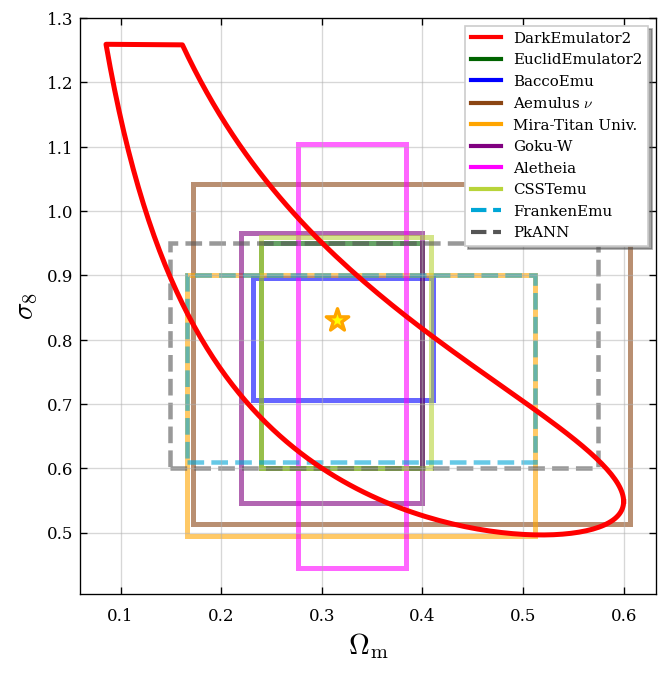
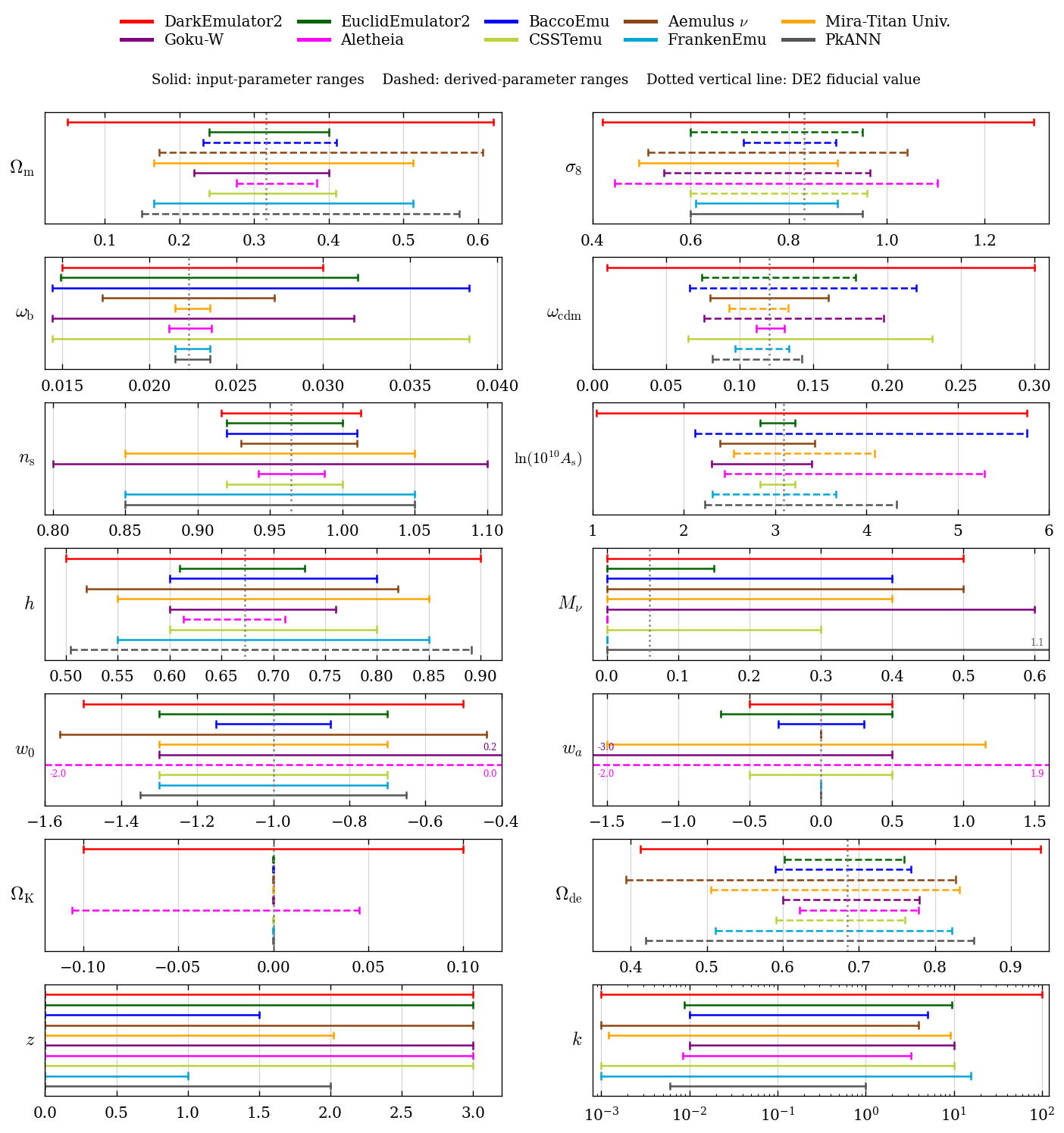
- These panels compare the parameter-space coverage of public nonlinear matter power-spectrum emulators.
- For each parameter, horizontal segments show the supported range of each emulator.
- Where necessary, we convert between physical densities and density parameters using \(\omega_i \equiv \Omega_i h^2\) (equivalently \(\Omega_i = \omega_i / h^2\)).
- In the right-hand panels:
- Solid lines denote the ranges of “native” input parameters used in the design of the emulator.
- Dashed lines indicate the ranges of derived parameters inferred from over 1,000 Monte Carlo samples of the input parameter space.
- The gray vertical dotted line marks the fiducial cosmology adopted for DarkEmulator2.
- Parameters extending beyond the frame of this diagram have their values printed near the corresponding bar.
Comparison at the DQ2 fiducial parameters
Comparison of public emulators with DE2
- PkANN (\(\nu w_0 \mathrm{CDM}\))
- FrankenEmu (\(w_0 \mathrm{CDM}\))
- Mira-Titan Universe II (\(\nu w_0 w_a \mathrm{CDM}\))
- Mira-Titan Universe IV (\(\nu w_0 w_a \mathrm{CDM}\))
- EuclidEmulator2 (\(\nu w_0 w_a \mathrm{CDM}\))
- BaccoEmu (\(\nu w_0 w_a \mathrm{CDM}\))
- CSST Emulator (\(\nu w_0 w_a \mathrm{CDM}\))
- Aemulus \(\nu\) (\(\nu w_0 \mathrm{CDM}\))
- GokuNEmu (\(N_\mathrm{eff} \alpha_s \nu w_0 w_a \mathrm{CDM}\))
- Aletheia (\(w_0 w_a \Omega_k \mathrm{CDM}\))
Pairwise emulator comparisons
- Pairwise comparison of total matter \(P(k)\). Each entry compares the row emulator with the column emulator.
| row / column | DE2 | EE2 | BaccoEmu | MTU IV | Aemulus \(\nu\) | GokuNEmu | Aletheia | CSST Emulator |
|---|---|---|---|---|---|---|---|---|
| EE2 | DE2 vs EE2 | - | - | - | - | - | - | - |
| BaccoEmu | DE2 vs BaccoEmu | EE2 vs BaccoEmu | - | - | - | - | - | - |
| MTU IV | DE2 vs MTU IV | EE2 vs MTU IV | BaccoEmu vs MTU IV | - | - | - | - | - |
| Aemulus \(\nu\) | DE2 vs Aemulus \(\nu\) | EE2 vs Aemulus \(\nu\) | BaccoEmu vs Aemulus \(\nu\) | MTU IV vs Aemulus \(\nu\) | - | - | - | - |
| GokuNEmu | DE2 vs GokuNEmu | EE2 vs GokuNEmu | BaccoEmu vs GokuNEmu | MTU IV vs GokuNEmu | Aemulus \(\nu\) vs GokuNEmu | - | - | - |
| Aletheia | DE2 vs Aletheia | EE2 vs Aletheia | BaccoEmu vs Aletheia | MTU IV vs Aletheia | Aemulus \(\nu\) vs Aletheia | GokuNEmu vs Aletheia | - | - |
| CSST Emulator | DE2 vs CSST Emulator | EE2 vs CSST Emulator | BaccoEmu vs CSST Emulator | MTU IV vs CSST Emulator | Aemulus \(\nu\) vs CSST Emulator | GokuNEmu vs CSST Emulator | Aletheia vs CSST Emulator | - |